
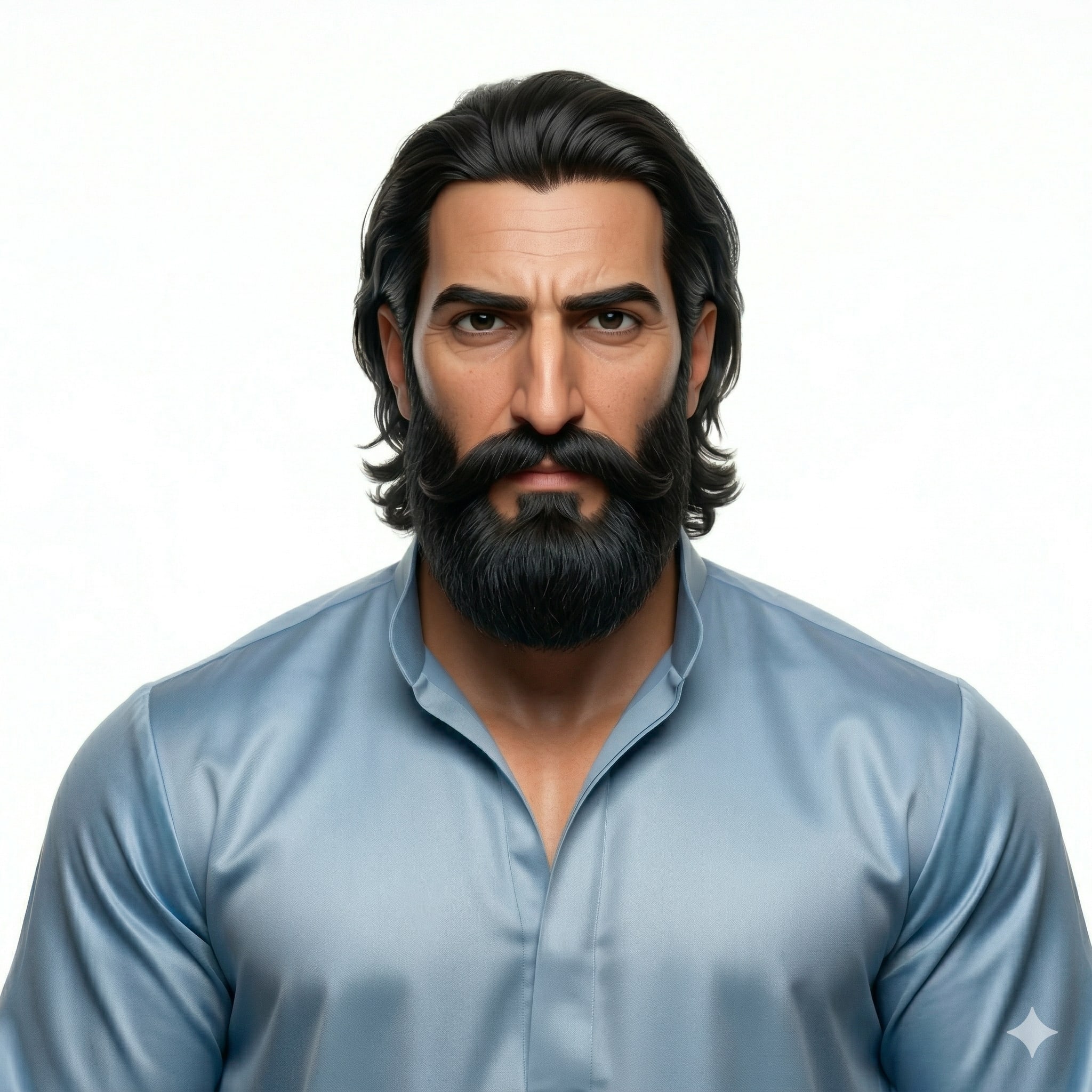
Key Khosrow (کیخسرو)
Key Khosrow, son of the Iranian prince  Siavash and the Turanian princess
  Farangis, which already makes him less a “king” and more a diplomatic paradox with a birth certificate.
His father is murdered by his maternal grandfather,  Afrasiab, before he is even born. So his origin story starts with “your family tree is actively trying to collapse in on itself.” He is raised in secret in the wilderness, because court politics apparently decided childhood was optional.
Then, eventually, he comes back. Because this story doesn’t do “staying hidden” as a permanent solution.
He avenges Siavash by defeating and executing Afrasiab and  Garsivaz. Same method, mirrored outcome. This universe really enjoys symmetry in violence, like it’s aesthetically satisfying or something.
Chosen by his paternal grandfather,  Key Kavus, he becomes king of Iran and brings with him something unusual for this setting: “Khosravani Wisdom,” a kind of near-enlightenment state. Which is suspicious, because most rulers here peak at “strategic impulse decision-making under emotional distress.”
He also owns a legendary cup, a crystal globe filled with an elixir. It reflects the entire world. All seven heavens. All distant suffering. He uses it to locate things like the missing hero  Bijan, because apparently omniscience is just another administrative tool when you’re tired of guessing where people are.
Then comes war again, because peace is not structurally supported here.
He launches a massive campaign against Turan to avenge Siavash properly. Afrasiab is killed, along with Garsivaz. Again, mirrored execution, narrative closure, same violence reflected back like a correction rather than an ending.
He rules for 60 years. Long enough to build stability, long enough to become dangerous to attachment.
Then he does something no one else in this story manages cleanly: he steps down voluntarily.
He gives away his possessions, renounces power, and goes into the mountains to pray. A divine vision confirms what he already seems to know: he is not meant to stay.
He appoints Key Lohrasp as successor, a distant relative chosen for wisdom and piety, not conquest. Which, in this universe, is already suspiciously peaceful.
Then he walks into the Alborz mountains to ascend.
A group follows him: Gudarz, Giv,  Rostam,
  Zal, Bijan, and others. Legendary heroes, all chasing a man who has decided not to be followed.
He warns them of a supernatural blizzard. Tells them to turn back. Some do. Some hesitate. All of them are already too late to change the direction of what this moment is becoming.
That night, he bathes in a spring, dresses in white, and says:
“When the sun rises, you will not see me again.”
And he is correct.
At dawn, he is gone. No body. No footprints. No evidence. Just absence where a king used to be.
The others search. Refuse to accept it. Exhaust themselves on a mountain that doesn’t care about belief.
Then the storm comes, exactly as foretold. A massive, unnatural blizzard. It buries Giv, Bijan, and the rest as they sleep, turning refusal into permanence.
The mountain takes them.
And Key Khosrow becomes something rare in this world: not just a king who wins wars, but one who exits reality on his own terms, leaving behind both prophecy and disappearance as proof that power doesn’t always end in defeat.
According to Zoroastrian tradition, he doesn’t even stay gone. He’s scheduled for a return at the end of time, to assist the final renewal of the world alongside the savior, Soshyans.
So even absence, in this story, is just delayed responsibility.
Parents
Grandparents
